







Top-Top Info Worldwide is a popular online newsportal and going source for technical and digital content for its influential audience around the globe.

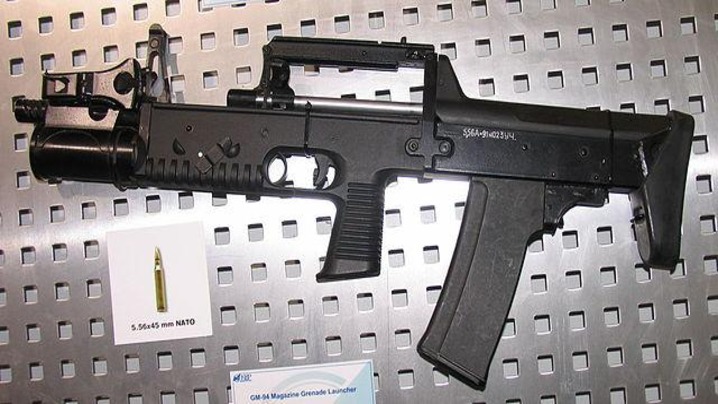
Russian and Soviet rifles are often discussed through hype, battlefield mythology, or imprecise labels. The term “AK-47,” for example, is routinely applied to many rifles that are actually AK, AKM, AK-74, or foreign derivatives. This overview focuses on historical development and identification at a high level. It does not rank lethality or provide instructions for use.
The rifle developed from Mikhail Kalashnikov’s postwar design work entered Soviet production at the end of the 1940s. Early production versions used both stamped and later milled receivers as manufacturing methods evolved. Its significance lay in combining selective fire with an intermediate cartridge in a package suitable for mass issue. The familiar “AK-47” name is useful in popular conversation, but specialists distinguish the prototype designation from the production AK.
Adopted around the end of the 1950s, the AKM returned to a stamped receiver and incorporated changes that reduced weight and supported efficient mass production. It became one of the most widely distributed Soviet rifle patterns and was manufactured or copied in many countries. That global production is why visual identification requires caution: markings, receiver details, and national variations matter more than a generic silhouette.
The Soviet Union adopted the AK-74 in the 1970s with a smaller 5.45×39 mm cartridge. The rifle retained the broad Kalashnikov operating concept while introducing a new magazine profile and other visible changes. Later versions, including the AK-74M, consolidated features for general service. The transition reflected a wider international move toward smaller-caliber, high-velocity service ammunition during the Cold War.
The AN-94 emerged from a late Soviet competition and was adopted in Russia during the 1990s. It used a mechanically complex system intended to improve the placement of the first two rounds in a burst. That engineering ambition came with cost, complexity, and training demands. It never displaced the Kalashnikov family as the dominant general-issue platform, making it historically interesting precisely because technical novelty did not translate into broad adoption.
The AK-12 represents Russia’s effort to update the Kalashnikov pattern for contemporary accessories, ergonomics, and production requirements. Publicly observed examples have changed across development and service, so photographs labeled “AK-12” may show different generations. Recent Small Arms Survey research has documented AK-12-pattern rifles among weapons seized from illicit trafficking in Ukraine, while noting that older AK-74-pattern rifles remained much more common in the reviewed records.
A responsible history therefore connects design to institutions: factories, procurement, doctrine, alliances, exports, and arms-control challenges. It also avoids treating weapons as isolated consumer products. Their historical importance includes the conflicts in which they circulated and the long-term burden created when state stockpiles move into illicit markets.
Terminology also matters for public understanding. Precise identification supports historical research, stockpile accounting, tracing, and efforts to prevent weapons from moving into unauthorized hands.
Sources: Small Arms Survey identification handbook; Small Arms Survey research note; Small arms production in Russia; Small Arms Survey 2025 Ukraine report.
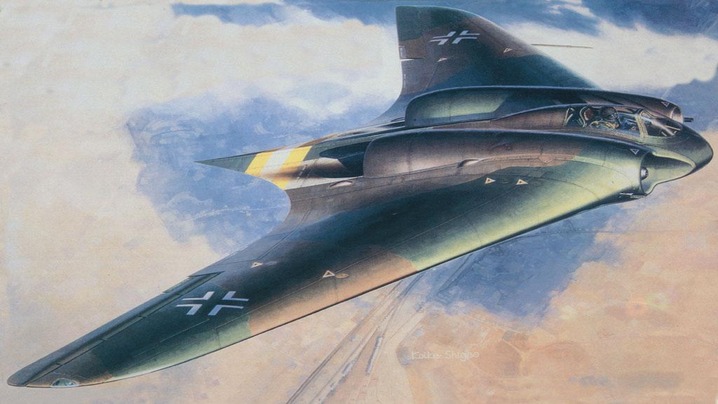
The project was a response to Hermann Goering demand for a light bomber that could carry 1,000 kilograms for 1,000 kilometers at a speed of 100 kilometers per hour. The result was a flying wing design that did more than its creators realized.
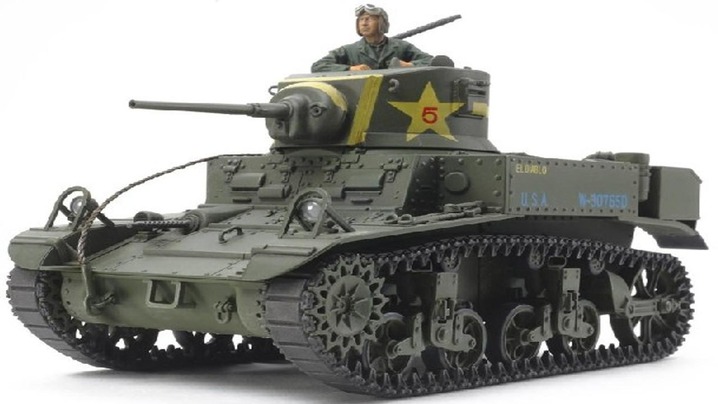
The URL’s wording appears to confuse Allied tanks with “alien” tanks. There is no credible evidence of extraterrestrial technology in Second World War armored vehicles. The useful historical question is how Allied armies designed, produced, maintained, and employed tanks under very different conditions.
No single tank was best at everything. Armor, firepower, mobility, reliability, crew workload, transport, fuel, and ease of repair all involved tradeoffs. The M3 Stuart, M4 Sherman, and Churchill illustrate three distinct approaches.
The American M3 light tank entered mass production in 1940 and reached British forces in North Africa in 1941. It carried a 37 mm main gun and had a crew of four. Crews appreciated its mechanical reliability and speed, but its fighting compartment was awkward and its gun and armor were increasingly inadequate against later opponents.
That did not make the Stuart useless. As heavier vehicles became available, it shifted toward reconnaissance, screening, liaison, and other duties where mobility mattered more than fighting enemy medium tanks head-on. It also served across many armies and theaters. The lesson is that an older tank can remain valuable when commanders adjust its role to match its capabilities.
The Sherman became the most widely used Allied medium tank. Its reputation is often distorted by comparisons that isolate gun and armor thickness from the larger war. The M4 was reliable, comparatively easy to drive and maintain, suitable for mass production, and adaptable to different engines, guns, recovery equipment, amphibious systems, and engineering tasks.
Early 75 mm Shermans were effective against many battlefield targets, especially infantry positions and field defenses. By 1944 they could be outgunned by Panthers and Tigers in some encounters, prompting use of the American 76 mm gun and the British 17-pounder Firefly. Yet tank-versus-tank duels were only one part of armored warfare. Availability, spare parts, recovery, trained crews, artillery, air support, and the ability to keep formations moving were strategic advantages.
Britain designed the Churchill as an infantry tank, emphasizing armor and the ability to cross broken terrain rather than speed. Early versions suffered serious reliability and armament problems, but the design improved. Later Churchills served in North Africa, Italy, and northwest Europe, where their climbing ability and protection could be valuable.
The chassis also supported specialized vehicles. On D-Day, Churchill-based engineering tanks helped assault forces cross obstacles and attack fortifications. These machines show why judging a tank only by its main gun misses its relationship to infantry and engineers.
A fair comparison asks what year, theater, mission, and variant are involved. A Stuart in 1941 is not the same proposition as one facing late-war anti-tank weapons. A Sherman optimized for dependable operational movement should not be judged solely against the frontal armor of a rare heavy tank. A Churchill’s slow road speed mattered less when its task was to accompany infantry over terrain other vehicles struggled to cross.
Crew survival and human experience also belong in the assessment. Visibility, escape hatches, ammunition placement, communications, fatigue, and maintenance conditions affected outcomes. Tanks did not fight as isolated machines; they operated in units connected to infantry, artillery, logistics, intelligence, and recovery teams.
The three vehicles were not futuristic wonders. Their significance came from practical engineering, industrial capacity, adaptation, and the people who operated and sustained them.
Sources: The Tank Museum: M3 Stuart; The Tank Museum: M4 Sherman; The Tank Museum: Churchill; The Tank Museum: tanks on D-Day.
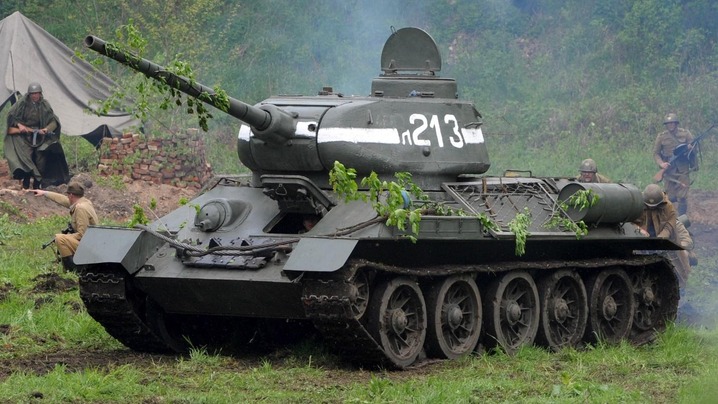
Soviet armored forces fought under extraordinary pressure after Germany invaded in June 1941. Factories and workers moved east, losses were immense, and designs had to be produced, repaired, and improved while the war continued. A tank’s historical value therefore cannot be reduced to armor and gun size. Production volume, reliability, training, communications, terrain, and tactical employment mattered.
The T-34, KV-1, and IS-2 represent different stages and functions. They were not flawless machines, and their crews paid a severe human cost. Together they show how Soviet tank design responded to a changing battlefield.
The early T-34 combined sloped armor, wide tracks, a diesel engine, and a 76.2 mm gun. In 1941, those features surprised German forces. Its mobility across soft ground and snow suited conditions on the Eastern Front, while its design could be manufactured in very large numbers.
Early operational performance was less simple than the legend. Many crews had limited training; radios were not universal; visibility and ergonomics were poor; and the two-person turret forced the commander to help load or aim while also directing the crew. Mechanical reliability varied, especially amid rushed wartime production.
By 1943, newer German tanks and improved anti-tank guns exposed the T-34/76’s limits. The T-34/85 answered with a more powerful 85 mm gun and a larger three-person turret, improving command efficiency. It became a major vehicle in the Soviet advance into Eastern Europe and remained in service internationally long after 1945.
The KV-1 heavy tank carried armor that many German weapons struggled to defeat in 1941. In favorable circumstances, that protection made individual vehicles formidable. But armor is only useful if a tank reaches the fight and can maneuver once there. The KV was heavy, mechanically troublesome, and difficult to operate. Its early gun offered no major firepower advantage over the lighter T-34.
As German anti-tank capability improved, the KV-1’s protection became less exceptional while its mobility penalty remained. At Kursk in 1943 it was already approaching the end of frontline relevance. Its importance lies in the shock it presented early in the invasion and in the experience it provided for later Soviet heavy tanks.
The IS-2 entered service late in the war as a heavy tank intended to attack fortified positions and confront heavily armored opponents. Its 122 mm gun fired a powerful high-explosive shell useful against bunkers and buildings, and it could defeat major German tanks under suitable conditions. Thick frontal armor improved protection.
The design also involved compromises. Large two-piece ammunition limited the number of rounds carried and reduced the rate of fire. The vehicle was not a universal replacement for the T-34. It served as a specialized breakthrough tank within combined formations, where infantry and supporting arms remained essential.
Soviet success depended on far more than three models. Light tanks, self-propelled guns, Lend-Lease vehicles, repair units, rail transport, artillery, and enormous industrial mobilization all mattered. Design simplification helped sustain output, but it could also burden crews with rough finishes, poor comfort, and limited situational awareness.
Calling one vehicle the “best” hides these tradeoffs. The T-34 was the indispensable mass medium tank; the KV-1 was an influential but increasingly inefficient early heavy; and the IS-2 delivered late-war protection and firepower for demanding assaults. Their value came from how each fit a particular time and mission—not from a timeless ranking.
Sources: The Tank Museum on Soviet tanks at Kursk; The Tank Museum: T-34/85; The Tank Museum: KV-1; The Tank Museum on Soviet heavy assault vehicles.
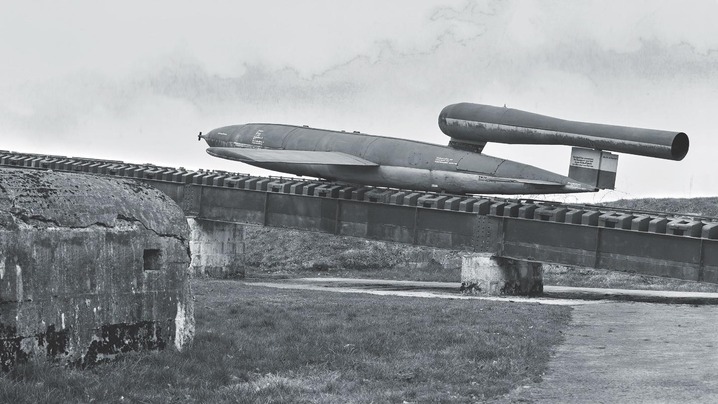
Nazi Germany’s long-range weapons are often described as technological marvels ahead of their time. The V-1 and V-2 did introduce important guidance, propulsion, and aerodynamic concepts, but “pioneering” is not the whole story. They were weapons aimed largely at cities, arrived too late to change Germany’s defeat, consumed scarce resources, and were produced within a system of imprisonment and lethal forced labor.
The label Vergeltungswaffe, or “vengeance weapon,” was propaganda. It framed attacks as retaliation after Allied bombing and promised a dramatic reversal. In practice, the weapons were inaccurate by modern standards and suited to terrorizing broad urban areas rather than striking precise military targets.
The V-1 was a small unmanned aircraft powered by a pulsejet. Launched from ramps or carried by aircraft, it flew on a preset course using a simple guidance system. Its engine produced the distinctive sound that led to the nickname “buzz bomb.” When the engine stopped, the weapon descended toward its target.
V-1 attacks on London began in June 1944, shortly after the Normandy landings. Later launches targeted Antwerp and other locations. The system was cheaper and simpler than the V-2, but defenses could respond. Radar warning, barrage balloons, anti-aircraft guns, fighter interception, attacks on launch sites, and the Allied advance across launch areas reduced its effectiveness.
The V-2, developed as the A-4, was a liquid-fueled rocket with gyroscopic guidance. It rose along a ballistic trajectory and struck at supersonic speed, giving people at the target no practical warning. Operational attacks began in September 1944 against cities including London and Antwerp.
The V-2 represented a major engineering step in large rocket engines, guidance and control, and supersonic flight. It was also an inefficient weapon: expensive, complex, limited in payload, and insufficiently accurate to achieve the strategic claims made for it. Its psychological effect was substantial, but it could not halt Allied armies or destroy the industrial capacity sustaining them.
The V-3 was not a rocket. It was a multi-charge long-range gun intended to fire projectiles from a large fixed installation toward London. Allied bombing disrupted the principal site at Mimoyecques in France, and the system never fulfilled its planned role. Other projects included air-launched missiles, anti-aircraft rockets, and experimental designs that remained incomplete.
Grouping these systems as “Hitler’s rockets” can exaggerate personal authorship and blur technical categories. Hitler approved priorities and intervened in programs, but large teams of military officials, engineers, firms, and laborers designed and produced the weapons. Institutional choices—not one man’s ingenuity—turned research into a terror campaign.
After British bombing damaged Peenemünde, V-2 production moved underground to the Mittelwerk complex near the Mittelbau-Dora concentration camp. Prisoners excavated tunnels and assembled missiles under murderous conditions. NASA’s historical account states that enslaved labor was used and that brutal conditions caused a high death toll. Any technological history that treats production as a neutral engineering achievement erases the people who paid for it.
The moral accounting is especially stark because more people died in the forced-labor system associated with V-2 production than were killed by the missile in Britain. Exact totals vary by scope, but the central fact is not disputed: exploitation and death were integral to production, not an incidental footnote.
After the war, the United States, Soviet Union, Britain, and other powers seized hardware, documents, and expertise. Under Operation Paperclip, the United States brought German specialists, including Wernher von Braun, to work on missile programs. Captured V-2s launched at White Sands supported high-altitude research, and later rockets drew on lessons from German work alongside independent American advances.
This legacy must be stated with both technical and ethical clarity. The V-2 influenced Cold War missiles and space launch vehicles, but that influence did not cleanse its origins. Governments often prioritized strategic knowledge over accountability, creating a continuing debate about who received opportunity, whose crimes were investigated, and whose suffering was marginalized.
The V-weapons demonstrate that advanced technology can be militarily ineffective, politically seductive, and morally catastrophic at the same time. Understanding all three dimensions is more accurate than celebrating a list of “top rockets.”
Sources: Imperial War Museums: German V-Weapons; NASA: Wernher von Braun and the V-2; U.S. Holocaust Memorial Museum: Dora-Mittelbau; NASA: Captured V-2 Research.
Top-Top Info Worldwide is a popular online newsportal and going source for technical and digital content for its influential audience around the globe.